
Maximum likelihood is a very general approach developed by R. A. Fisher, when he was an undergrad. In an earlier post, Introduction to Maximum Likelihood Estimation in R, we introduced the idea of likelihood and how it is a powerful approach for parameter estimation. We learned that Maximum Likelihood estimates are one of the most […]
Catplot Python Seaborn: One Function to Rule All Plots With Categorical Variables

I just discovered catplot in Seaborn. Catplot is a relatively new addition to Seaborn that simplifies plotting that involves categorical variables. In Seaborn version v0.9.0 that came out in July 2018, changed the older factor plot to catplot to make it more consistent with terminology in pandas and in seaborn. The new catplot function provides […]
Book Review – Data Visualization: A Practical Introduction

Data Visualization: A Practical Introduction by Duke University Professor Kieran Healy is a great introduction Data Visualization. If you have not heard of the book before, here is a little back story. The author, Kieran Healy developed the book using R Bookdown and made the whole book available online for free. Yes, it is available […]
Introduction to Maximum Likelihood Estimation in R – Part 1

The core of statistical inference can thought of situation like this. You have some observed data and you want to understand the actual population that generated the sample data you have. Parameter estimation by MLE One typically models that the observed data is generated by some probability distribution. For the sake of simplicity, let us […]
How To Make Grouped Boxplots in Python with Seaborn?
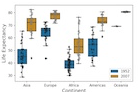
Boxplots are one of the most common ways to visualize data distributions from multiple groups. In Python, Seaborn potting library makes it easy to make boxplots and similar plots swarmplot and stripplot. Sometimes, your data might have multiple subgroups and you might want to visualize such data using grouped boxplots. Here, we will see examples […]